Showing posts with label logical philosophy. Show all posts

Wednesday, May 22, 2013

56. Equivalence and Formal Rules


Harold R. (Hal) Foster’s Prince Valiant

© Respective copyright/trademark holders.

“In mathematics, the greatest degree of self-evidence is usually not to be found quite at the beginning, but at some later point; Hence the early deductions, until they reach this point, give reasons rather for believing the premises because true consequences follow from them, than for believing the consequences because they follow from the premises.”




Dan DeCarlo The greatest of all time comic book artist!

Archie Andrews Gang   © Respective copyright/trademark holders.


Harold R. (Hal) Foster’s Prince Valiant

© Respective copyright/trademark holders.


Artists unknown © Respective copyright holders.


Pencils: Stan Goldberg  Inks: Jon D'Agostino Josie Gang 
TM & © Respective copyright/trademark holders.


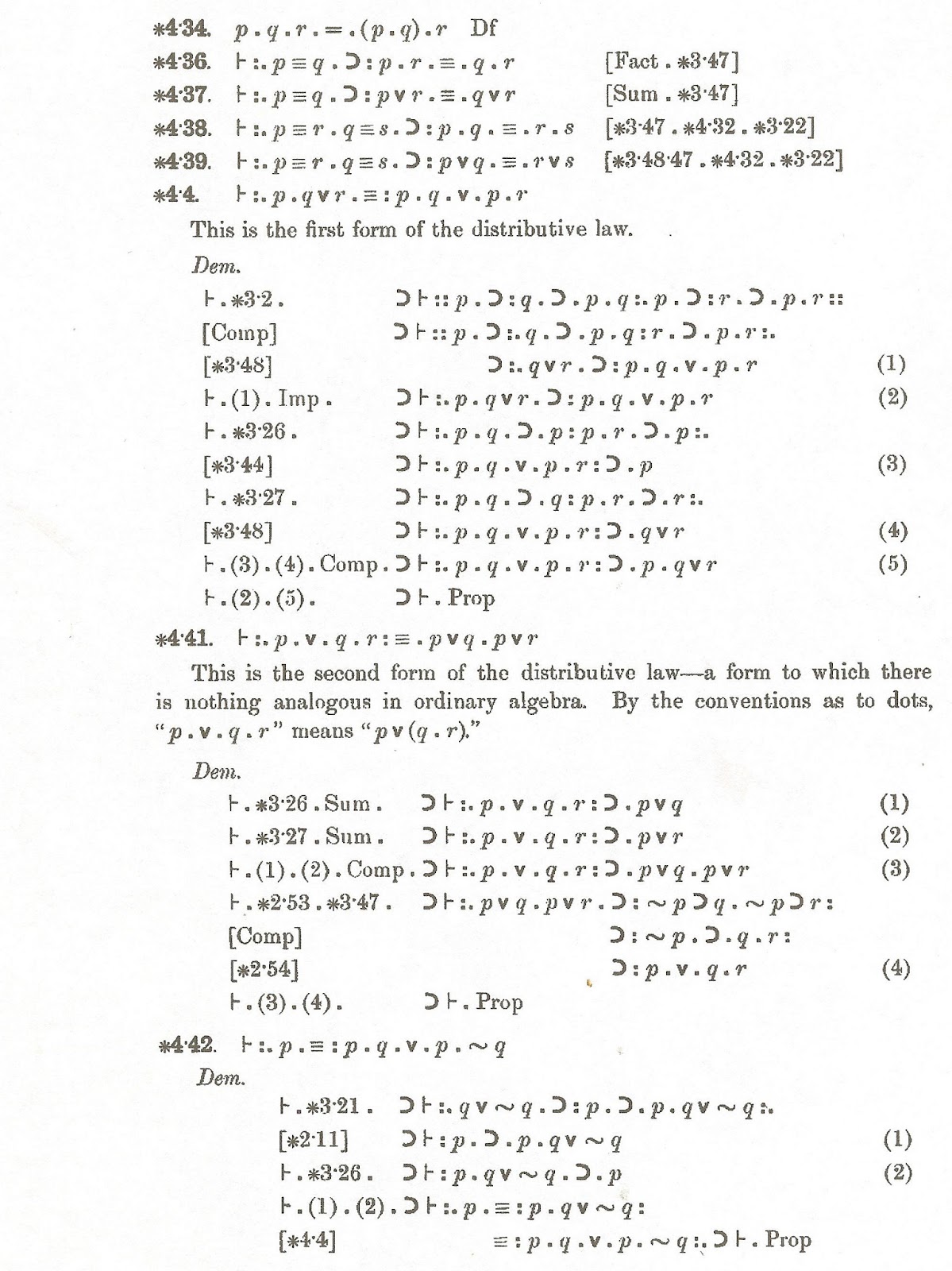
 Personally I approach this work with great confidence, and so very much of its apparent complexity melts away. The oppressive notations that the authors felt that (rightly) it was necessary to include in order hold the attention of conventional mathematicians, skeptical, at best, of this, then very modern work. By laying their proofs with each proceeding proposition and the extensive demonstrations of certain further proofs. By now we should be well able to read these equations and discern at least some varying meaning from them. Just to repeat the key to opening up an understanding to this section, all propositions are to be numbers which are all either 1 or 0.

    Treated as a "calculus," the rules of deduction are capable of many other interpretations. But all other interpretations depend upon the one here considered, since in all of them we deduce consequences from our rules, and thus presuppose the theory of deduction. One very simple interpretation of the "calculus " is as follows: The entities considered are to be numbers which are all either 0 or 1; "p:) q" is to have the value 0 if p is 1 and q is 0; otherwise it is to have the value 1;, p is to be 1 if p is 0, and 0 if p is 1; p. q is to be 1 if p and q are both 1, and is to be 0 in any other case; p v q is to be 0 if p and q are both 0, and is to be 1 in any other case; and the assertion-sign is to mean that what follows has the value 1. Symbolic logic considered as a calculus has undoubtedly much interest on its own account; but in our opinion this aspect has hitherto been too much emphasized, at the expense of the aspect in which symbolic logic is merely the most elementary part of mathematics, and the logical prerequisite of all the rest. For this reason, we shall only deal briefly with what is required for the algebra of symbolic logic.      
 
I can’t help wondering if Whitehead and Russell may have erred in dismissing the binary calculus that runs our computers today. It seems to be right on the tip of their tongues. Still they clearly had other fish to fry, and this work certainly demanded a focused attention.

Harold R. (Hal) Foster’s Prince Valiant

© Respective copyright/trademark holders.

Sunday, April 14, 2013

55. The Logical Product Of Two Propositions


Harold R. (Hal) Foster’s Prince Valiant
© Respective copyright/trademark holders.


Story and Art: John Stanley and Irving Tripp  Little Lulu 
© Respective copyright/trademark holders.


Illustration: Meyers - 1912 Outdoor Life & Indian Stories

Harold R. (Hal) Foster’s Prince Valiant
© Respective copyright/trademark holders.

Big Chief Western  Feb 1941

I am a bit slow sometimes. After reading this material over and over I have finally realized what has been bothering me. I understand the material easily on a visceral level, but the descriptions, and most especially the proofs built in by the authors are a great labor for me to digest, and I have been feeling frustrated by this. Now after so many re-readings I managed to penetrate the systems order of proofs; though I am sure it is clear enough to someone with a more mathematical bend of mind.
Still even as I am back to enjoying this material again, I do have to take a bit of time to digest it before making each future post, and it seems for now about every two weeks will be the best I can manage.


Superman and Supergirl © TM Respective copyright/trademark holders.


Harold R. (Hal) Foster’s Prince Valiant
© Respective copyright/trademark holders.

Thursday, March 14, 2013

53. *2. Immediate Consequences Of The Primative Propositions


Harold R. (Hal) Foster’s Prince Valiant
© Respective copyright/trademark holders.

I don’t like to go so long between posts here, but my progress has been slowed for a number of reasons. I must confess chief among them is the diminished interest in the topic I feel at present. I am not mathematical by nature, and have spent forty years in ducking learning about it as much possible. However my work here has sparked an interest in learning more; and although my desire has not yet caught fire I feel it is only a matter of time before I reach more clarity with this. In addition the equations involved introduce typographical issues which are laborious to transcribe and require very much more effort to proofread.  Also I cannot post as text because this blog won’t support it. So I have to print and scan each post, and then if I spot an error after publishing it is an ordeal to correct it.

Why bother? I just adore the complexity of Whitehead and Russell’s work. Just look at the post below: 1350+ words comprise less than half of the summary of this part describing the immediate consequences of the primitive propositions! I think it is also wise to point out here that M. Jean Nicod published a paper demonstrating that our primitive propositions *1-*6 can be replaced with one single primitive proposition. I hasten to add that M. Nicod did so with the benefit of having studied our authors work, and for this reason I feel it is imperative to have at our text as written, for my purpose is to assimilate the work at hand before departing from it.


Script: Bob Wood? Pencils & Inks: Alan Mandel© Respective copyright/trademark holders.


Harold R. (Hal) Foster’s Prince Valiant
© Respective copyright/trademark holders.


Script: Bob Haney  Pencils & Inks: Bernard Baily © Respective copyright/trademark holders.


Harold R. (Hal) Foster’s Prince Valiant
© Respective copyright/trademark holders.